
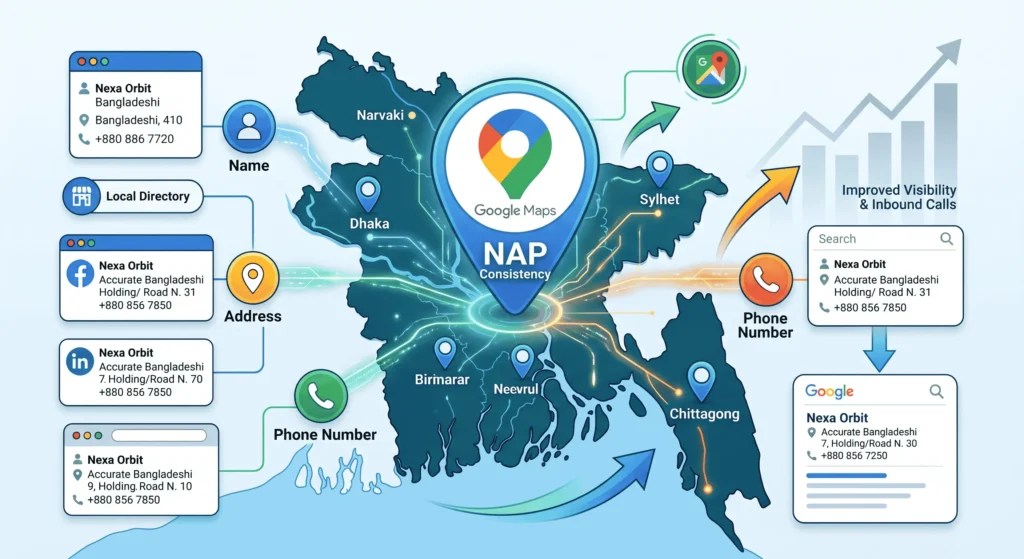
If you run a service business in Dhaka, Chittagong, or Sylhet, a single spelling mistake in your business address can push your brand completely out of Google Maps. I see local business owners spend hundreds of thousands of BDT on Facebook ads while their organic Google listings languish on page three. The culprit is almost always broken local data. Google crawls the web to verify if your business is trustworthy, and when it finds conflicting information, it drops your visibility.
Maintaining precise business details across the web is the bedrock of local search performance. In Western markets, software platforms handle this automatically. In Bangladesh, where street addresses change format based on who is writing them, you have to manage this process manually.
This guide breaks down exactly how to audit, clean up, and protect your business data across the web. I will show you how I handle the chaotic directory ecosystem in Bangladesh so you can secure a permanent position in the local map pack.
What NAP Consistency Bangladesh Actually Means
NAP consistency Bangladesh refers to the exact alignment of a business’s Name, Address, and Phone number across every website, directory, social media platform, and map service on the internet. It is a critical local SEO signal that helps search engines verify the physical location and legitimacy of a service business. If your business details vary between your website and third-party listings, search engines lose confidence in your data.
When we talk about name address phone consistency, we are looking at character-for-character accuracy. For example, if your company is listed as “Nexa Orbit” on your website, but appears as “Nexa Orbit Ltd.” on a local business listing, Google treats these as two slightly different entities. This mismatch fractures your local authority.
The address component is particularly volatile in the Bangladeshi digital space. A variation as small as writing “Road 11, Banani” on one profile and “Road #11, Block-E, Banani” on another breaks your structural pattern. Your goal is to establish one single version of truth that every directory on the web mirrors perfectly.
Why Data Consistency Matters in 2026
Google uses third-party data sources to perform local entity verification. It does not just trust what you type into your Google Business Profile (GBP). Instead, its algorithm constantly cross-references your GBP data with yellow pages, local blogs, government registration databases, and social profiles.
Many mainstream SEO marketers claim that directory listings are dead. They are wrong. While low-quality, automated directory spam no longer works, high-authority NAP citations Bangladesh remain a primary pillar for establishing local trust. If Google finds three different phone numbers or two different variations of your shop address across the web, it lowers your ranking to protect its users from outdated information.
In our local market, the physical address system is notoriously unstandardized. Holding numbers, road numbers, block designations, and neighborhood names are frequently mixed up by users. Because search engines rely heavily on clean semantic data to power AI search results and map placements, a business with clean, matching data across 20 premium listings will consistently beat a competitor with messy data across 100 listings.
The Foundations
Building a clean local footprint requires establishing your core data set before you submit information to any external platform.
Establishing the Golden Profile
Your first step is to choose one exact format for your business details. This format must be saved in a shared document that your team can copy and paste from directly. I recommend using your verified Google Business Profile as the absolute baseline.
Open your GBP dashboard and copy your business name, address, and primary phone number exactly as they appear. If your business name uses English, do not mix Bangla translations on other platforms unless you are intentionally creating a separate multi-lingual map strategy. Stick to one language variant for your core citations to avoid confusing search engine crawlers.
On-Page Schema Optimization
Once you have your master data format, you must embed it into your website using structural code. Do not just type it in the footer as plain text. You need to use LocalBusiness JSON-LD schema markup so search engine spiders can read your exact location variables without ambiguity.
Place this markup globally in your website header or specifically on your contact page. Ensure that the phone number matches the international formatting standard (+880 for Bangladesh) if that is how you have entered it elsewhere. Any mismatch between your website’s hidden schema code and your public map listing hurts your local entity verification process.
Cleaning Up Your Core Social Channels
Your Facebook Page, LinkedIn Company Profile, and Instagram Business account are high-authority nodes that Google crawls constantly. These profiles often rank on the first page of search results for your brand name, making their data integrity critical.
Log into your Facebook Page business suite and check the About section. Look for trailing spaces, missing block numbers, or old mobile numbers that you used before shifting to a proper corporate helpline. If you accept customer inquiries via bKash or Nagad on a separate number, keep that out of the primary phone field; only list your core business line there.
Advanced Tactics for Tricky Bangladeshi Addresses
Managing local SEO in cities like Dhaka requires specific workarounds for complex, non-standard address systems.
Standardizing Holding Numbers vs Road Names
Dhaka addresses are often written in two completely different ways for the exact same building. A landlord might use a holding number (e.g., “Holding 42/A”), while customers navigate using the road name (e.g., “House 12, Road 5, Dhanmondi”). This causes severe issues for GBP NAP alignment.
To fix this, choose the format that Google Maps natively displays when you drop a pin on your building. If Google Maps registers your location as “Road 10, Mirpur 11,” use that specific structure across all your directory listings. Do not try to append holding numbers to your citations if Google does not recognize them in its map database, as this creates structural fragmentation.
[Unstandardized Address Variant A] ──► Holding 42/A, Dhanmondi
├──► [Confuses Google Bot]
[Unstandardized Address Variant B] ──► House 12, Road 5, Dhanmondi
[Correct Solution] ──────────────────► Copy exact string displayed on Google Maps native pin
Handling Multi-Storey Commercial Buildings
If your service business operates from a high-rise building in areas like Gulshan or Motijheel, you face the challenge of shared addresses. Fifty other businesses might share the exact same building address on Google Maps, making it hard for search engines to distinguish your specific entity.
Always include your floor or suite number cleanly across all profiles using a consistent abbreviation. Decide whether you will use “Floor 4,” “Level 4,” or “Suite 4B.” Pick one and enforce it everywhere. If you need to dive deeper into how your site architecture matches your location data, review my comprehensive guide on Technical SEO Audit Bangladesh to fix crawling issues.
Resolving Local Phone Number Formats
Many Bangladeshi service businesses use multiple mobile numbers or swap between a landline and a mobile helpline. This breaks your phone consistency completely.
Select one single mobile number or an IP phone number (like a 096 number) as your primary contact point. Use this exact number across all business listings. If you have secondary numbers for sales or support, list them clearly on your website’s contact page, but never use them as the primary number on external directories or map listings.
Common Mistakes
- Using Different Names for Brand Extensions: Adding keywords to your business name on directories (e.g., writing “Nexa Orbit SEO Specialist” on one site and just “Nexa Orbit” on another) triggers algorithmic filters for spam.
- Neglecting Old Locations After Moving: If your office moves from Uttara to Banani, leaving old listings active with the Uttara address destroys your map rankings because Google detects conflicting physical signals.
- Automating Local Subscriptions via US Platforms: Using international automated citation tools like Yext or BrightLocal often fails in Bangladesh because they do not integrate deeply with local regional platforms.
- Allowing Public Edits to Stand Unchecked: Users can suggest edits to your business profiles on Google Maps. If you do not monitor your dashboard, a competitor or user might change your phone number or address format without your knowledge.
- Creating Duplicate Map Listings: Setting up multiple Google Business Profiles for the same physical office to target different keywords splits your review authority and creates massive NAP conflict.
- Using Shared Tracking Numbers Incorrectly: Implementing dynamic number insertion (DNI) for ad tracking without excluding your local SEO landing pages replaces your consistent core phone number with temporary numbers that web scrapers index.
Tools for Managing Local Entity Verification
Google Business Profile Dashboard
This is your primary tool for monitoring your core data. Check the “Edits” tab at least once a month to ensure Google has not automatically altered your address strings based on user feedback or automated street scans.
Ahrefs (Batch Analysis & Link Intersect)
In Ahrefs, I look at the Link Intersect report to find local directories where my top competitors have secured links or mentions. If three competitors are listed on a specific local business directory, it means that platform holds regional contextual authority, and I need to build a matching citation there.
Local Search Results Checker
Tools like BrightLocal’s free search checker allow you to view search results from exact coordinates within Dhaka or Chittagong. This helps you see if your NAP changes are successfully improving your map rankings across different parts of a city.
Real Example
When managing localized visibility strategies, data accuracy is the deciding factor between growth and stagnation. I led local SEO strategies for Pro Dry Carpet Cleaning, a service brand operating in a highly competitive regional market. By enforcing strict name address phone consistency and executing a comprehensive citation cleanup program, we eliminated data conflicts across dozens of regional business listings.
The result of this rigorous data alignment speaks for itself. The business secured a 80.2% Share of Local Voice in its target geography and generated a consistent stream of 169 inbound calls per month purely from organic map visibility. We did not achieve this through shortcuts; we achieved it by ensuring that every single digital mention of the brand matched its core profile perfectly.
Frequently Asked Questions
Do I need to use Bangla text for my citations to rank well in Bangladesh?
No, it is not mandatory. Google crawls and processes both English and Bangla text seamlessly. The critical factor is consistency; choose the language that matches your primary customer search behavior and stick to that exact script across all your profiles.
How do I fix incorrect business listings on sites I do not own?
You must manually claim the listing on that specific directory platform. Most local directories have a “Claim Business” or “Owner?” link where you can verify ownership via email or phone and then correct the broken data fields.
Will a change in my phone number immediately drop my map rankings?
You will likely see a short-term fluctuation while Google updates its index. To minimize the impact, keep your old phone number listed as a secondary number inside your GBP dashboard while setting your new number as the primary contact point.
Are social media profiles counted as local citations by Google?
Yes, highly authoritative platforms like Facebook, LinkedIn, and YouTube are crawled heavily for entity validation. A mismatched phone number or address on your corporate Facebook page can directly suppress your Google Maps performance.
How long does a citation cleanup take to show results in search engines?
Local data synchronization is a slow process. It typically takes between 4 to 12 weeks for search engine crawlers to discover, index, and re-evaluate your updated information across various third-party directories.
Can I use a P.O. Box address for my local business listings?
No. Google’s guidelines strictly prohibit using P.O. Boxes or remote mail drop locations for local business profiles. You must use a legitimate physical storefront or an office address where your staff is physically present during stated hours.
Next Steps
Now that you understand how to align your business data, your next step is to drive real user validation to your profiles. Go read my step-by-step strategy on How to Get Google Reviews Bangladesh to turn your consistent data into high-ranking map visibility.
If you want to scale your entire digital storefront beyond local map packs, check out my Ecommerce SEO Services page to see how I build comprehensive search campaigns for expanding service businesses.