
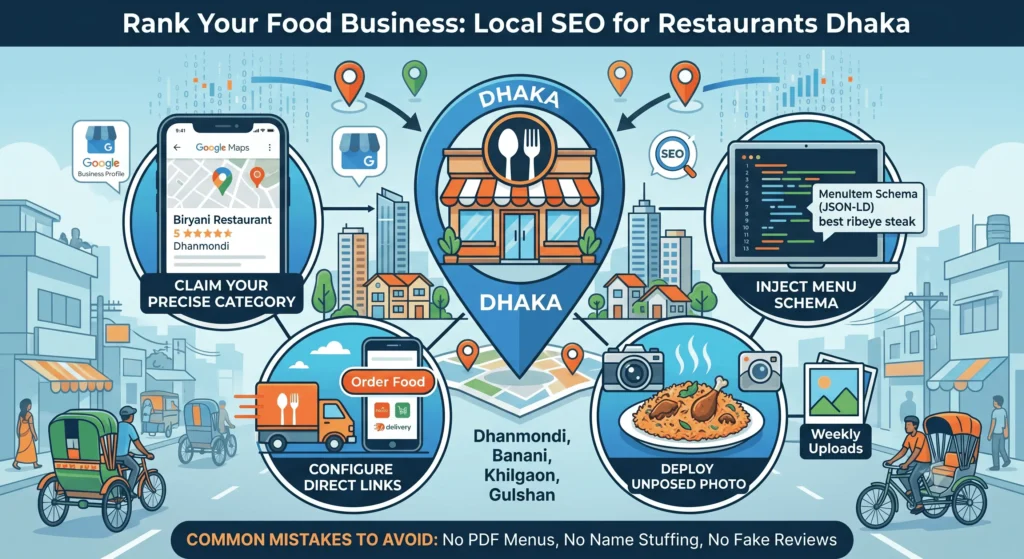
Most restaurant owners in Dhanmondi, Banani, and Khilgaon think building a beautiful Instagram feed is the only way to fill tables. They spend heavily on food influencers and paid Facebook boosts while completely ignoring customers who search Google for “best restaurants near me.” When hungry diners look for specific dishes in their immediate area, they skip social media feeds and use Google Maps to make instant decisions.
Failing to optimize your search footprint means your tables stay empty during critical lunch and dinner rushes. Google uses hyper-local signals to determine which eateries appear in the coveted local 3-pack. If your profile is generic or unoptimized, search bots will route hungry diners directly to your closest competitors down the street.
I have spent years configuring local search assets from my practice in Mirpur. I worked alongside the Nexa Orbit team on aggressive localized positioning models, like our Pro Dry campaign which secured an 80.2% Share of Local Voice. This step-by-step tutorial reveals the exact optimization blueprint required to dominate local SEO for restaurants Dhaka, ensuring your kitchen stays busy.
Before You Start
Before editing your digital menu assets or uploading imagery, gather your primary business access credentials.
- Estimated Time: 3 to 4 hours for full configuration.
- Difficulty Level: Intermediate.
- Prerequisites: Full ownership access to your Google Business Profile (GBP) and admin access to your website’s content management system (CMS).
What You Need
- An active, verified Google Business Profile.
- High-resolution, unedited, candid food photos of your actual menu items.
- Your restaurant menu structured cleanly in a digital text format.
The Desired Outcome
After executing this process, your restaurant will rank prominently for localized food queries, capture direct map reservation links, and generate consistent foot traffic from local search maps.
Step 1: Claim Your Precise Restaurant Categories and Menu Attributes
Setting up a general category is the fastest way to dilute your restaurant SEO Bangladesh footprint. You must tell the algorithm exactly what your kitchen specializes in so it can match you with hyper-specific user cravings.
- Navigate to your Google Business Profile dashboard and click on Edit profile.
- Under the About tab, click on the Business category section.
- Select your primary category with absolute precision (e.g., choose “Biryani Restaurant” or “Japanese Restaurant” instead of just “Restaurant”).
- Add highly relevant secondary categories like “Cafe,” “Coffee shop,” or “Delivery Restaurant” if you operate multi-faceted food setups.
- Scroll down to More attributes and check the boxes for specific amenities, such as “Dine-in,” “Takeout,” or “Outdoor seating.”
Common Pitfall: Selecting too many conflicting secondary categories. Adding “Italian Restaurant,” “Chinese Restaurant,” and “Bakery” to a single physical spot confuses the entity engine and lowers your overall contextual relevance scores.
Step 2: Inject Structured Menu Schema into Your Website Backend
Search engine crawlers cannot read printed paper menus or text locked inside flat JPEG images uploaded to your site. To rank for dish-specific searches (like “best ribeye steak in Gulshan”), you must deploy clean structured code that search engines can easily parse.
- Open your website’s CMS or text editor and locate your primary menu page.
- Use a structured code editor to build a native MenuItem and Menu schema block using JSON-LD format.
- Define your distinct sections cleanly: name the section, list the individual dish name, add a brief description of ingredients, and state the exact price in BDT.
- Paste this code block directly into the header HTML section of your dedicated menu page.
[Raw Paper Menu] ──► [Converted to Text Strings] ──► [Structured JSON-LD Schema]
│
(Injected to Header)
│
▼
[Search Bots Index Specific Dishes]
When checking competitive landscapes using tools like Ahrefs, I examine the Top Pages report of top-ranking eateries to see which menu paths bring them organic traffic. Adding actual text-based prices alongside your schema data prevents search engines from misinterpreting your pricing tiers.
Step 3: Configure Direct Food Delivery and Reservation Links
Your food business SEO Dhaka plan must make the conversion path seamless for mobile searchers. If a user has to search around your profile just to find a way to order, they will bounce back to the map pack.
- Inside your GBP dashboard, click on the Food ordering or Booking icon.
- Review the third-party provider integrations that Google automatically pulls onto your profile (such as Foodpanda or local delivery links).
- If you run an in-house delivery team or use an independent ordering portal, click Add a link under the preferred pickup/delivery option.
- Enter your direct, un-redirected ordering URL and set it as the primary option.
- Save the configuration and verify the button shows up cleanly on mobile viewports within 24 hours.
Step 4: Deploy Unposed, Geo-Contextual Food Photos Weekly
Google tracks user image views as a heavy behavioral validation signal. Polished studio graphics with marketing text overlays look fake to search crawlers and perform poorly. You need realistic, unposed imagery that looks authentic.
- Take high-resolution photos of your dishes inside your actual dining room using natural light.
- Keep natural details in the frame, like real steam rising or condensation on a drink glass, to prove authenticity.
- Log into your GBP mobile app or desktop dashboard, click Add photo, and select Photo.
- Upload 3 to 5 fresh photos every single week, separating them cleanly into food, drink, and interior categories.
- Encourage your customers to take photos at their tables and upload them directly along with their reviews.
Step 5: Execute an Active Local Keyword Review Loop
Diners look for specific dishes and food items, not just your brand name. Your review replies must highlight these specific keywords naturally to boost your topical authority.
- Go to your dashboard and click on Read reviews.
- For every positive review detailing a dining experience, write a unique, personal reply within 48 hours.
- Include your restaurant’s signature dish and location naturally in your text (e.g., “Thank you for trying our slow-cooked mutton biryani here in Dhanmondi!”).
- For negative review handling, respond professionally within 12 hours, offer a direct phone line to resolve the issue, and avoid using defensive language.
Common Mistakes to Avoid
- Uploading PDF-Only Menus: Forcing users to download large PDF files on slower mobile connections destroys your conversion rates and stops search engines from indexing your food items.
- Keyword Stuffing the Business Name: Writing titles like “Chillox Dhanmondi – Best Burgers in Dhaka” violates Google’s guidelines and will trigger an automated profile suspension.
- Buying Fake Map Reviews: Purchasing cheap review packages from local social media groups will get your listing permanently filtered out or banned by Google’s anti-spam systems.
- Ignoring Neighborhood Mentions: Leaving out localized target neighborhoods (like Khilgaon, Banani, or Uttara) from your website’s meta titles limits your reach to your immediate street block.
What to Do Next
Once your restaurant profile is fully optimized, ensure your foundational data remains uniform across all independent web directories. Read my guide on Local Citation Sources Bangladesh to claim and clean your listings on high-authority local indices.
To expand your digital footprint past the map pack and optimize your core landing pages, review my Ecommerce SEO Services page to see how I build comprehensive keyword optimization campaigns.
FAQ
How long does it take for a new Dhaka restaurant to rank in the local pack?
You can expect to see initial map ranking shifts within 4 to 8 weeks after executing a full optimization strategy, depending on competition levels in areas like Gulshan or Dhanmondi.
Can I rank for food delivery queries if my kitchen is located in a residential area?
Yes. You can configure your profile as a Service Area Business (SAB) inside your dashboard, hiding your residential street address while setting clear delivery neighborhood boundaries.
Do I need to update my online menu prices every time they change in the restaurant?
Yes. Mismatched pricing between your Google profile, website schema, and physical menu frustrates customers and hurts your data accuracy signals.
Should I respond to star-only reviews that don’t include any text?
Yes. Always write a brief, polite response to all star-only ratings to show search engines that your business listing is actively managed.