
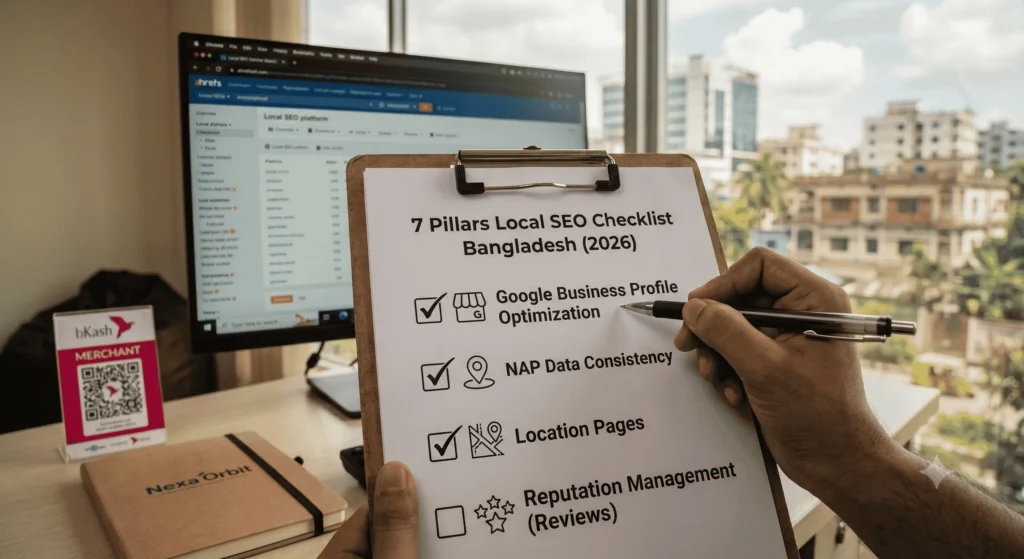
Most business owners in Dhaka waste money on generic marketing tactics that completely ignore how local search actually works. You need a highly specific local SEO checklist Bangladesh strategy to capture active buyers in your area. I have spent the last six years ranking businesses across the globe and right here at home. I audit 47 specific technical points when taking on a new client. I cannot cover all 47 micro-tasks in a single post. Instead, I grouped those exact 47 items into seven core execution pillars.
This guide is for serious business owners and in-house marketers who want actionable steps. By the end of this post, you will know exactly which areas of your digital presence require immediate attention. You will understand how to structure your location data and where to allocate your marketing budget for maximum return. I will show you exactly what I do to generate calls and foot traffic for real clients.
How I Chose These Essential Local SEO Checklist Bangladesh
I selected these seven pillars based strictly on what moves the needle in real search engine results pages. Google updates its local algorithm constantly. Many old tactics simply fail to generate traffic today. I built this local SEO checklist 2026 framework by analyzing the actual performance data of my successful consulting clients.
I ignored theoretical advice and focused entirely on practical execution. A complete local SEO strategy requires prioritizing tasks that generate the highest return on investment. If a tactic does not directly contribute to higher visibility or better conversion rates, I exclude it from my daily workflow.
My evaluation criteria for these seven pillars include:
- Direct impact on local map pack rankings
- Ability to generate qualified phone calls or direct sales
- Relevance to the mobile-heavy Bangladeshi consumer market
- Measurable return on investment within a three to six month window
1. Google Business Profile Setup: The Local Visibility Engine
What it is: The complete optimization of your business entity within Google Maps and local search results.
What it’s best for: Dominating local search results instantly and capturing high-intent phone calls.
Pricing: Claiming the profile is completely free from Google. Professional management software costs around 3,000 BDT to 10,000 BDT monthly.
What I use it for: I treat GBP optimization as the absolute foundation of my entire Google Maps SEO checklist. I never start an engagement without securing this asset first. I worked alongside the Nexa Orbit team on the Pro Dry Carpet Cleaning campaign in Fort Lauderdale. We optimized their profile specifically for “carpet cleaning + [city]” and utilized precise category selections. I actively manage the Q&A section with exact match keywords based on actual customer inquiries. I upload high-resolution images of the exterior and interior weekly. I use the insights tab constantly to monitor the exact search terms triggering the profile. This exact method helped Pro Dry Carpet Cleaning secure 169 inbound calls per month and an 80.2% Share of Local Voice. I apply this exact same rigor to every Bangladeshi physical business I consult.
Pros:
- Generates immediate inbound phone calls from local buyers
- Provides robust analytics on customer discovery methods
- Integrates seamlessly with Google Maps navigation
Cons:
- Google support is notoriously difficult to contact during suspensions
- Competitors frequently attempt malicious profile edits
- Strict verification processes often delay initial launch
Verdict: This is a mandatory requirement for any physical business wanting local visibility.
2. NAP Consistency Audits: The Trust Signal Validator
What it is: The rigorous standardization of your Business Name, Address, and Phone number across all online directories.
What it’s best for: Building entity trust with search engines and preventing algorithmic confusion.
Pricing: Manual auditing costs only your time. Automated citation tools like BrightLocal run approximately 3,500 BDT per month.
What I use it for: I use strict NAP auditing to fix broken trust signals that hold websites back. Inconsistent data confuses search crawlers and actively suppresses rankings. I start by pulling a full citation report to find every variation of a client address. I manually correct discrepancies across major data aggregators and local Bangladeshi directories like the Bangladesh Business Directory. I ensure the phone number formatting matches the website exactly. I used this specific citation cleanup process for Border Locksmith in Australia. By standardizing their NAP data across 50 regional directories, I helped build the trust required to take them from zero to 7,537 monthly organic visits. I never skip this step because foundational errors here multiply down the line.
Pros:
- Creates a solid foundation of algorithmic trust
- Improves referral traffic from niche local directories
- Prevents customer frustration caused by wrong phone numbers
Cons:
- Manual cleanup is incredibly tedious and time-consuming
- Some directory webmasters never respond to update requests
- Data aggregators occasionally overwrite your manual corrections
Verdict: Fixing your NAP profile is the cheapest way to remove artificial ranking ceilings.
3. Location Pages Creation: The Neighborhood Net
What it is: Dedicated landing pages built specifically to target individual cities or neighborhoods.
What it’s best for: Capturing organic search traffic from areas where you do not have a physical office.
Pricing: Content creation costs depend on the writer. Expect to spend 2,000 BDT to 8,000 BDT per high-quality page.
What I use it for: I use hyper-specific location pages to expand a service area beyond a single zip code. You cannot rank in the map pack for a city ten miles away. You can rank in the standard organic results with a perfectly optimized page. I structure these pages carefully. I include custom neighborhood descriptions, local driving directions, and embedded Google Maps. I also feature client testimonials specific to that exact neighborhood. I use Screaming Frog to verify these pages sit properly within the website architecture hierarchy. I ensure these pages never duplicate content. Each page provides unique value relevant to the specific geography.
Pros:
- Bypasses the physical proximity limits of the map pack
- Captures highly targeted long-tail local search queries
- Allows for precise internal linking to core service pages
Cons:
- Requires significant investment in original copywriting
- Poorly executed pages often trigger duplicate content penalties
- Takes longer to rank than map pack listings
Verdict: You absolutely need these pages if you service multiple areas from a single central office.
4. Strategic Reputation Management: The Conversion Catalyst
What it is: The proactive system of requesting, monitoring, and responding to customer feedback online.
What it’s best for: Turning visibility into actual revenue by establishing overwhelming social proof.
Pricing: Basic request systems are free. Automated SMS review platforms cost between 5,000 BDT and 20,000 BDT monthly.
What I use it for: I use aggressive reputation management to win the click when a client ranks next to three competitors. Ranking first means nothing if you have a 3.2 rating and the second result has a 4.9 rating. I implement automated follow-up sequences for my clients. I require them to ask for reviews immediately after a successful transaction. I draft templates for responding to both positive and negative reviews. I specifically include localized LSI keywords in the review responses naturally. Google scans these reviews for entities and context. I monitor the velocity of incoming reviews carefully. A steady stream of positive feedback directly correlates with sustained map pack stability.
Pros:
- Dramatically increases click-through rates from search results
- Provides user-generated content that search engines love
- Builds immense brand equity in your local market
Cons:
- Requires consistent effort and staff training to execute
- One disgruntled customer can temporarily tank your rating
- Fake negative reviews from competitors require tedious appeals
Verdict: You must prioritize review velocity if you want to convert searchers into paying customers.
5. Local Schema Implementation: The Machine Language
What it is: Specialized JSON-LD code injected into your website to feed exact business data to search engines.
What it’s best for: Spoon-feeding your entity details to Google without relying on their semantic understanding.
Pricing: Free to generate manually. Premium WordPress plugins like Schema Pro cost around 10,000 BDT annually.
What I use it for: I write custom local schema to guarantee Google understands exactly who my client is and what they do. Standard SEO relies on Google interpreting your text correctly. Schema removes the guesswork. I define the exact latitude and longitude, the official logo, the exact opening hours, and accepted payment methods. In Bangladesh, explicitly listing bKash, Nagad, and local bank transfers in the schema builds local relevance. I utilized highly customized product and organization schema for Boddibari, a Bangladeshi organic hair care D2C brand. This technical foundation helped them scale from zero to 1.79 million Google impressions in just ten months. I validate every script through the Google Rich Results Test before deploying it live.
Pros:
- Guarantees search engines understand your exact business entity
- Qualifies your site for rich snippets in the search results
- Provides a distinct technical advantage over less savvy competitors
Cons:
- Requires basic understanding of code structure to implement manually
- Broken syntax can completely invalidate the entire markup
- Requires regular updating if your business details change
Verdict: Adding validated schema markup is a non-negotiable technical requirement for serious local campaigns.
6. Mobile First Technical SEO: The Speed Imperative
What it is: The structural optimization of your website to prioritize fast loading and flawless rendering on mobile devices.
What it’s best for: Satisfying user intent and passing Google Core Web Vitals metrics.
Pricing: Developer costs vary wildly. Technical SEO consulting for mobile optimization typically starts around 40,000 BDT per project.
What I use it for: I use mobile technical optimization to ensure local searchers never abandon a client site out of frustration. The Bangladeshi market is overwhelmingly mobile-first. Many users operate on slower 3G or unstable 4G networks outside central Dhaka. I compress all images using modern WebP formats. I defer non-essential JavaScript that blocks the main rendering thread. I increase the size of tap targets like phone numbers and CTAs. If a user cannot click the “Call Now” button effortlessly with their thumb, the site fails. I use Ahrefs to monitor the Core Web Vitals report specifically looking at the mobile tab. I refuse to compromise on mobile loading speed because it directly dictates the conversion rate.
Pros:
- Directly aligns with Google mobile-first indexing protocols
- Massively reduces bounce rates from impatient local users
- Improves overall conversion rates across all traffic channels
Cons:
- Often requires expensive developer intervention to fix legacy code
- Balancing high-quality images with fast load times is difficult
- Third-party tracking scripts often destroy your speed metrics
Verdict: Your website must load in under three seconds on a mobile device or you will lose the lead.
7. Localized Link Acquisition: The Authority Builder
What it is: The deliberate strategy of earning backlinks from other websites located in your specific geographic area.
What it’s best for: Proving to search engines that your business is a deeply integrated part of the local community.
Pricing: Varies heavily. Sponsoring a local event might cost 15,000 BDT. Custom digital PR campaigns can exceed 100,000 BDT.
What I use it for: I build local authority by acquiring links that competitors cannot simply buy on a freelance marketplace. Generic guest posts do very little for local rankings. I look for neighborhood associations, local news outlets, and regional business groups. I encourage clients to sponsor local Dhaka events or sports teams to secure legitimate local links. I analyze competitor backlink profiles in Ahrefs, sorting by referring domains to find local opportunities they missed. I frequently use this exact strategy as part of my broader ecommerce SEO in Bangladesh campaigns. A link from a trusted Bangladeshi news portal carries massive geographic weight. I focus entirely on relevance over raw domain metrics.
Pros:
- Creates an incredibly resilient and defensible backlink profile
- Drives highly relevant referral traffic directly to your site
- Builds real-world networking opportunities alongside digital authority
Cons:
- Requires immense manual outreach and relationship building
- Cannot be easily scaled or automated like other SEO tactics
- Local webmasters often lack the technical skills to add links properly
Verdict: Local links are the ultimate tie-breaker when competing against established businesses in tight local markets.
Comparison Table
Here is a quick reference guide comparing these seven core pillars based on my daily consulting experience.
| Checklist Pillar | Primary Impact | Estimated Cost (BDT) | Time to Execute | Technical Difficulty |
| GBP Optimization | Map Pack Visibility | Free to 10,000/mo | Fast | Low |
| NAP Audits | Entity Trust | Free to 3,500/mo | Medium | Low |
| Location Pages | Organic Reach | 2,000 – 8,000/page | Medium | Medium |
| Reputation Management | Conversion Rate | Free to 20,000/mo | Ongoing | Low |
| Local Schema | Entity Clarity | Free to 10,000/yr | Fast | High |
| Mobile SEO | User Experience | 40,000+ per project | Slow | High |
| Local Links | Overall Authority | 15,000+ per link | Slow | High |
Which Should You Choose?
You cannot ignore any of these pillars if you want a dominant local presence. You must execute them in a specific logical order based on your current situation.
If you have a brand new business with zero budget, start immediately with GBP Optimization and Reputation Management. These two pillars cost nothing but time and directly generate revenue. You can manage your own profile and ask every single customer for a review personally.
If you have an established business struggling to pass a competitor, you must invest in Mobile First Technical SEO and Local Schema Implementation. These highly technical pillars require capital but they create a performance gap your competitors will struggle to close.
If your goal is regional domination across multiple cities, your budget must heavily favor Location Pages Creation and Localized Link Acquisition. You need raw authority and specific content to rank outside your immediate physical radius.
I strongly recommend reviewing my detailed Pro Dry Carpet Cleaning case study to see exactly how these pillars interact in a highly competitive market.
Frequently Asked Questions
Do I need a physical office in Bangladesh to rank in local search?
You need a verifiable physical address to qualify for a standard Google Business Profile. Google strictly prohibits using P.O. boxes or virtual offices for map pack verification. You can rank in standard organic results without a physical office by using optimized location pages.
How long does it take to see results from local SEO?
You will typically see initial map pack movement within 30 to 60 days after claiming and fully optimizing your profile. Ranking in highly competitive markets or pushing standard organic rankings often takes three to six months of consistent effort.
Is local schema markup really necessary for a small business?
Yes. Search engines prefer structured data over crawling plain text. Providing exact schema markup ensures Google never misinterprets your operating hours, location, or accepted payment methods.
How do I handle fake negative reviews from competitors?
You must flag the review immediately within your Google Business Profile dashboard. You should then respond professionally to the review stating you have no record of them as a customer. I recommend engaging Google support directly if the flagged review is not removed within five business days.
Does social media impact my local SEO rankings?
Social media does not directly impact the core local search algorithm. Active social profiles do claim more real estate on branded search queries and provide alternative avenues for customer discovery. I prioritize technical website SEO and map pack optimization over organic social media posting.